Agricultural Outlook 2025: Climate Impact on Crop Yields & Finance
Shifting climate patterns are set to significantly alter the agricultural outlook 2025, potentially impacting up to 20% of global crop yields and leading to substantial financial repercussions across the sector.
The agricultural outlook 2025 presents a complex picture, heavily influenced by increasingly unpredictable climate patterns. Farmers, policymakers, and consumers alike are bracing for a year that could see significant shifts in crop production, with projections indicating a potential 20% impact on global yields. This isn’t just about weather; it’s about the intricate dance between environmental shifts, economic stability, and food security.
understanding the 2025 climate forecast for agriculture
As we approach 2025, climate models offer a critical, albeit often unsettling, preview of what the agricultural sector might face. These forecasts are not merely academic exercises; they represent the foundation upon which planting decisions, risk management strategies, and market expectations are built. The primary drivers of concern include more frequent extreme weather events and gradual shifts in traditional growing seasons.
Scientists are increasingly confident in their projections of regional climate anomalies. For instance, some areas may experience prolonged droughts, while others could face unprecedented rainfall and flooding. These variations pose immense challenges for crop selection and irrigation planning, forcing farmers to adapt rapidly or risk significant losses.
key climate drivers for 2025
- El Niño/La Niña cycles: These oceanic phenomena profoundly influence global weather patterns, leading to regional droughts or excessive precipitation.
- Rising global temperatures: Even slight increases can stress crops, accelerate pest cycles, and alter water availability.
- Increased frequency of extreme weather: Heatwaves, cold snaps, and severe storms are becoming more common, directly damaging crops.
- Shifting precipitation patterns: Unpredictable rainfall timing and intensity make traditional farming calendars unreliable.
The convergence of these factors creates a volatile environment for agriculture. Understanding these climate drivers is the first step toward mitigating their potential impacts and preparing for a more resilient agricultural future in 2025 and beyond.
projected crop yield impacts across key regions
The anticipated climate patterns for 2025 are not expected to affect all regions or all crops equally. While some areas might experience favorable conditions, many major agricultural zones are bracing for significant reductions in yield. This uneven distribution could exacerbate global food disparities and impact international trade agreements.
North America, particularly the U.S. Midwest, a global breadbasket, faces potential challenges from both drought and intense rainfall events. Corn and soybean yields, crucial for global food and feed supplies, could be particularly vulnerable. Similarly, parts of Europe and Asia are predicted to experience heatwaves that could stress staple crops like wheat and rice.
vulnerable crops and regions
Different crops possess varying levels of resilience to climate stressors. For example, while some drought-resistant varieties are being developed, widespread adverse conditions can still overwhelm even the most robust crops. The financial implications for farmers in these regions could be devastating, leading to lower incomes and potential food security issues.
- Corn and Soybeans (U.S., Brazil, Argentina): Highly susceptible to drought and extreme heat during critical growth stages.
- Wheat (Europe, Russia, Australia): Vulnerable to early frosts, prolonged dry spells, and excessive moisture during harvest.
- Rice (Southeast Asia): Dependent on consistent water supply, making it susceptible to both droughts and floods.
- Specialty Crops (California, Mediterranean): Often require specific climatic conditions, making them sensitive to temperature shifts and water scarcity.
The cumulative effect of these regional impacts could lead to a global reduction in overall crop availability. This necessitates a proactive approach to agricultural planning, focusing on diversification and climate-smart farming techniques to safeguard future harvests.
financial repercussions for farmers and global markets
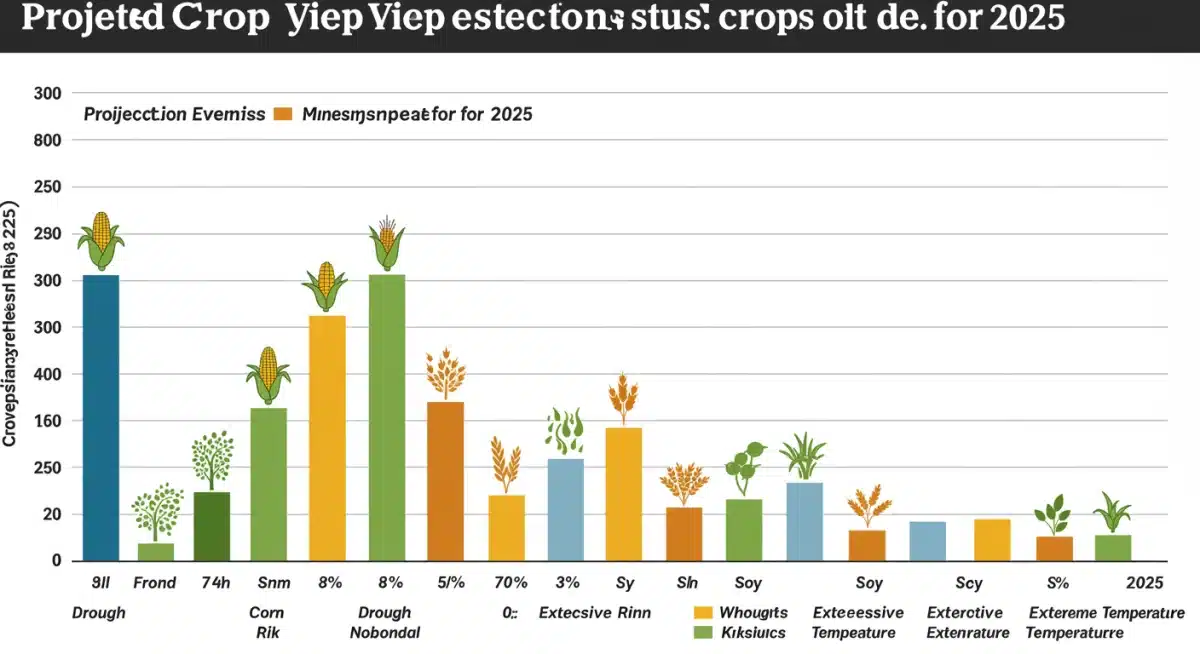
The potential 20% impact on crop yields in 2025 translates directly into significant financial repercussions, extending far beyond individual farms to influence national economies and global commodity markets. Farmers will face increased input costs, reduced revenues, and heightened risk, while consumers may see higher food prices and potential supply chain disruptions.
For farmers, lower yields mean less product to sell, often coupled with increased expenses for irrigation, pest control, or replanting. Insurance payouts can help, but they rarely cover the full extent of losses. This financial strain can lead to debt, reduced investment in future seasons, and even farm closures, particularly for smaller operations.
market volatility and consumer prices
Global commodity markets are inherently sensitive to supply fluctuations. A projected 20% reduction in key crop yields could trigger significant price increases, leading to market volatility. This directly impacts food processors, retailers, and ultimately, consumers.
- Commodity price spikes: Reduced supply often leads to higher prices for staple crops like corn, wheat, and rice.
- Increased food inflation: Higher agricultural commodity prices translate into increased costs for processed foods and groceries.
- Supply chain disruptions: Inconsistent yields can create bottlenecks in processing, transportation, and distribution.
- Impact on livestock industry: Higher feed costs (corn, soy) directly affect meat and dairy prices.
Governments and international organizations will need to monitor these trends closely, potentially implementing policies to stabilize markets and support vulnerable populations, as the financial stability of the agricultural sector underpins broader economic health.
recent updates in agricultural technology and adaptation strategies
In response to growing climate challenges, the agricultural sector is rapidly evolving, embracing new technologies and adaptation strategies designed to build resilience and mitigate yield losses. These innovations are crucial for navigating the uncertainties of the agricultural outlook 2025 and ensuring long-term food security.
Precision agriculture, for instance, utilizes data from sensors, drones, and satellites to optimize resource use, ensuring water and nutrients are applied exactly where and when needed. This not only conserves resources but also enhances crop health and yield potential, even under stressful conditions.
innovative approaches for resilience
Beyond technology, farmers are also adopting diverse farming practices that enhance soil health, biodiversity, and carbon sequestration. These practices, often grouped under ‘climate-smart agriculture,’ aim to make farms more robust against environmental shocks.
- Drought-resistant crop varieties: Genetic engineering and traditional breeding are developing crops that thrive with less water.
- Improved irrigation systems: Drip irrigation and smart sensors minimize water waste and optimize delivery.
- Agroforestry and cover cropping: These practices enhance soil moisture retention, reduce erosion, and improve soil fertility.
- Early warning systems: Advanced meteorological forecasting helps farmers make timely planting and harvesting decisions.
- Vertical farming and controlled environment agriculture: Offer climate-independent production for certain crops, reducing external dependencies.
These recent updates represent a proactive stance against climate change, offering hope that the agricultural sector can adapt and continue to meet global food demands despite challenging environmental forecasts.
government policies and international cooperation
Addressing the complex challenges outlined in the agricultural outlook 2025 requires more than individual farm-level adaptations; it demands robust government policies and concerted international cooperation. These frameworks are essential for providing support, incentivizing sustainable practices, and ensuring a coordinated global response to climate-induced agricultural disruptions.
Many governments are already implementing subsidies for climate-smart farming, investing in agricultural research, and developing risk management programs like crop insurance. These measures aim to buffer farmers from the immediate financial impacts of adverse weather and encourage the adoption of resilience-building practices.
key policy areas and collaborations
International cooperation is equally vital, particularly for addressing global food security and facilitating the exchange of knowledge and resources. Organizations like the FAO and various UN initiatives play a crucial role in coordinating efforts and sharing best practices across borders.
- Research and development funding: Government investment in developing climate-resilient crops and sustainable farming techniques.
- Crop insurance and disaster relief: Programs to protect farmers from financial ruin due to extreme weather events.
- International trade agreements: Policies that ensure fair access to food markets and prevent protectionist measures during crises.
- Carbon credit programs: Incentivizing farmers to adopt practices that sequester carbon, providing additional income streams.
- Knowledge sharing and extension services: Disseminating best practices and new technologies to farmers globally.
Through a combination of supportive domestic policies and collaborative international efforts, the agricultural sector can build a more resilient and sustainable future, better equipped to face the challenges of changing climate patterns.
strategies for agricultural resilience and sustainability
Building agricultural resilience and sustainability is paramount for navigating the challenging agricultural outlook 2025 and ensuring long-term food security. This involves a multi-faceted approach that integrates ecological principles with economic viability, moving beyond short-term fixes to create truly robust food systems.
One core strategy is diversifying crop portfolios. Relying on a single crop makes farms highly vulnerable to specific climate shocks or pest outbreaks. By growing a variety of crops, farmers can spread their risk and enhance the overall ecological health of their land, improving soil structure and nutrient cycling.
holistic approaches for a resilient future
Beyond crop diversification, a holistic approach to farm management considers the entire ecosystem. This includes managing water resources efficiently, promoting biodiversity, and reducing reliance on synthetic inputs. Such practices not only protect the environment but also often lead to more stable and productive farming systems in the long run.
- Water management innovation: Implementing rainwater harvesting, efficient irrigation, and water recycling techniques.
- Soil health improvement: Practices like no-till farming, cover cropping, and organic matter enrichment to boost soil fertility and water retention.
- Biodiversity enhancement: Integrating hedgerows, natural habitats, and beneficial insects to support pollination and pest control.
- Integrated pest management (IPM): Reducing chemical use through biological controls, resistant varieties, and targeted interventions.
These strategies collectively contribute to a more sustainable agricultural model, one that can withstand climatic pressures, reduce environmental impact, and support the livelihoods of farmers for generations to come, ensuring a more stable food supply for everyone.
| Key Point | Brief Description |
|---|---|
| Climate Impact | Projected 20% impact on global crop yields due to extreme weather and shifting patterns. |
| Financial Repercussions | Increased farmer costs, reduced revenues, market volatility, and higher food prices. |
| Adaptation Strategies | Adoption of precision agriculture, drought-resistant crops, and climate-smart farming. |
| Policy & Cooperation | Government support, R&D funding, and international collaboration are crucial for resilience. |
Frequently Asked Questions About the 2025 Agricultural Outlook
The primary climate patterns include intensified El Niño/La Niña cycles, rising global temperatures, and increased frequency of extreme weather events like droughts, heatwaves, and severe storms. These factors collectively disrupt traditional growing conditions and water availability, posing significant challenges for crop production worldwide.
A 20% impact on crop yields will lead to reduced harvest volumes and lower revenues for farmers. They will also likely face increased operational costs for irrigation, pest management, or replanting. This can result in financial strain, increased debt, and potentially force some smaller farms out of business, impacting rural economies.
Technology plays a crucial role through advancements like precision agriculture, which optimizes resource use with data-driven insights. Additionally, the development of drought-resistant crop varieties, smart irrigation systems, and early warning climate forecasting systems are vital tools for enhancing agricultural resilience and minimizing yield losses.
Global food prices are highly likely to increase as a direct consequence of reduced crop yields. Lower supply of staple commodities like corn, wheat, and soy typically drives up their market prices. This, in turn, translates to higher costs for processed foods and groceries, contributing to overall food inflation for consumers.
Governments are implementing various measures, including funding for agricultural research and development of climate-resilient crops, providing subsidies for sustainable farming practices, and offering comprehensive crop insurance and disaster relief programs. International cooperation agreements also aim to stabilize markets and share best practices globally.
Conclusion
The agricultural outlook 2025 underscores a period of significant challenge and transformation for global food production. With climate patterns projected to impact up to 20% of crop yields, the financial implications for farmers, markets, and consumers are substantial. However, through ongoing advancements in agricultural technology, the adoption of climate-smart farming practices, and robust governmental and international cooperation, the sector is actively building resilience. The path forward demands continuous innovation, strategic planning, and a collective commitment to sustainability to ensure food security in an increasingly unpredictable world.
Autor