2025 Tech Landscape: 5 Innovations Redefining US Industries
The 2025 tech landscape is rapidly evolving, with five breakthrough innovations poised to fundamentally redefine national industries across the United States through advanced AI, quantum computing, biotechnology, sustainable energy, and enhanced cybersecurity measures.
The 2025 tech landscape is not just on the horizon; it’s already here, demanding our attention and adaptation. This year promises to be a pivotal moment for national industries in the United States, as groundbreaking innovations emerge from research labs and integrate into our daily lives and economies. Understanding these shifts isn’t just about staying current; it’s about preparing for a future being shaped right now.
The Ascent of Artificial Intelligence: Beyond Automation
Artificial Intelligence (AI) has long been a buzzword, but in the 2025 tech landscape, its capabilities extend far beyond simple automation. We are witnessing the maturation of AI systems that can not only process vast amounts of data but also learn, adapt, and even generate creative content. This new era of AI is poised to revolutionize decision-making processes, operational efficiencies, and customer interactions across nearly every sector.
The impact of advanced AI is particularly pronounced in industries like healthcare, where diagnostic tools are becoming more precise, and drug discovery processes are accelerating. In manufacturing, AI-driven robotics and predictive maintenance systems are leading to unprecedented levels of productivity and reduced downtime. The financial sector is leveraging AI for fraud detection, personalized investment advice, and complex market analysis, offering greater security and tailored services to consumers.
AI in Healthcare and Diagnostics
In healthcare, AI’s role is expanding rapidly. From analyzing medical images with greater accuracy than human eyes to predicting disease outbreaks, AI is becoming an indispensable tool. This leads to earlier diagnoses and more effective treatment plans, ultimately improving patient outcomes.
- Precision Diagnostics: AI algorithms can identify subtle patterns in medical scans and lab results, enhancing diagnostic accuracy.
- Personalized Medicine: Tailoring treatments based on an individual’s genetic makeup and health data, leading to more effective therapies.
- Drug Discovery Acceleration: AI significantly speeds up the identification of potential drug compounds and streamlines clinical trials.
The integration of AI in these critical areas is not just an incremental improvement; it represents a fundamental shift in how medical professionals approach patient care and scientific research. It empowers practitioners with insights previously unattainable, fostering a new era of data-driven medicine.
Ultimately, AI’s evolution in the 2025 tech landscape signifies a move from assistive technology to a more collaborative intelligence, where human expertise is augmented by AI’s analytical prowess. This synergy is unlocking new potentials and driving industries towards unforeseen levels of innovation and efficiency.
Quantum Computing: Unlocking Unprecedented Processing Power
Quantum computing, once a theoretical marvel, is rapidly transitioning into a tangible reality within the 2025 tech landscape. This revolutionary form of computation harnesses the principles of quantum mechanics to solve problems that are currently intractable for even the most powerful classical supercomputers. Its potential applications span from complex material science to advanced cryptography, promising to reshape how we approach data and computation.
Industries heavily reliant on complex simulations and data optimization, such as pharmaceuticals, aerospace, and financial modeling, stand to gain immensely. Quantum computers could significantly accelerate the development of new materials, optimize logistics for global supply chains, and create unbreakable encryption methods, fundamentally altering the competitive landscape.
Quantum’s Impact on Material Science
The ability of quantum computers to model molecular interactions at an unprecedented scale opens doors for discovering and designing new materials with specific properties. This could lead to breakthroughs in energy storage, advanced manufacturing, and even sustainable technologies.
- Battery Technology: Designing more efficient and longer-lasting batteries for electric vehicles and renewable energy storage.
- Drug Development: Simulating molecular structures to create more effective and targeted medications.
- Aerospace Engineering: Developing lighter, stronger, and more heat-resistant materials for aircraft and spacecraft.
While still in its nascent stages, the progress in quantum computing is accelerating, with significant investments from both governments and private corporations. The challenges remain substantial, including maintaining quantum coherence and scaling up qubit counts, but the rewards for overcoming these hurdles are immense.
The advent of quantum computing in the 2025 tech landscape promises to be a game-changer, offering a leap in computational power that will enable solutions to some of humanity’s most pressing challenges. Its disruptive potential is undeniable, and industries are already beginning to explore how to integrate this powerful tool into their future strategies.
Biotechnology and Gene Editing: Reshaping Life and Health
Biotechnology, particularly in the realm of gene editing, is poised to make profound impacts on the 2025 tech landscape. Advances in technologies like CRISPR are moving beyond the laboratory, offering unprecedented precision in modifying genetic code. This capability has far-reaching implications for human health, agriculture, and environmental sustainability, promising to address some of the most persistent global challenges.
In medicine, gene editing holds the promise of curing genetic diseases at their source, rather than just managing symptoms. This could lead to revolutionary treatments for conditions like cystic fibrosis, Huntington’s disease, and certain cancers. Beyond human health, biotechnology is transforming agriculture, creating crops that are more resilient to disease, pests, and climate change, thereby enhancing food security.
CRISPR and Therapeutic Breakthroughs
CRISPR-Cas9 technology has revolutionized gene editing due to its relative simplicity and high precision. This has opened new avenues for therapeutic interventions, offering hope for patients with previously untreatable genetic disorders.
- Genetic Disease Cures: Directly correcting faulty genes responsible for inherited conditions.
- Cancer Immunotherapy: Engineering immune cells to more effectively target and destroy cancer cells.
- Viral Resistance: Developing strategies to make human cells resistant to viral infections.
The ethical considerations surrounding gene editing are complex and necessitate careful societal dialogue and regulatory frameworks. However, the scientific potential to alleviate suffering and improve quality of life is undeniable, driving continued research and development in this field.
As biotechnology continues its rapid advancement within the 2025 tech landscape, it challenges our understanding of life itself and presents opportunities to fundamentally reshape our biological future. The careful balance between innovation and ethical responsibility will be crucial in harnessing its full potential for the benefit of all.
Sustainable Energy Solutions: A Global Imperative
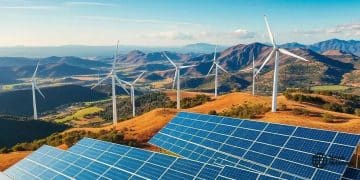
The imperative for sustainable energy solutions has never been more urgent, and the 2025 tech landscape reflects a significant acceleration in this area. Innovations in renewable energy generation, storage, and distribution are rapidly evolving, promising to mitigate climate change and establish energy independence for nations. This shift is not merely environmental; it represents a massive economic opportunity and a redefinition of industrial infrastructure.
Advancements in solar panel efficiency, wind turbine technology, and geothermal energy extraction are making renewable sources more competitive and reliable than ever before. Crucially, breakthroughs in battery technology and grid management systems are addressing the intermittency challenges inherent in many renewable sources, paving the way for a truly integrated and resilient clean energy infrastructure.
Advancements in Energy Storage
Energy storage is key to the widespread adoption of renewables. New battery chemistries and grid-scale storage solutions are making it possible to store excess energy generated during peak production times for use when demand is high or renewable output is low.
- Solid-State Batteries: Offering higher energy density and improved safety for electric vehicles and stationary storage.
- Flow Batteries: Scalable solutions for grid-level storage, capable of long-duration discharge.
- Hydrogen Fuel Cells: Emerging as a viable option for heavy transport and industrial applications, offering clean energy conversion.
Beyond generation and storage, smart grid technologies are optimizing energy distribution, reducing waste, and enhancing grid resilience against disruptions. These intelligent systems use AI and machine learning to predict demand, manage supply, and even integrate distributed energy resources from individual homes and businesses.
The transition to sustainable energy in the 2025 tech landscape is a monumental undertaking, requiring significant investment and policy support. However, the long-term benefits—environmental, economic, and geopolitical—make it an unavoidable and transformative force for national industries.
Advanced Cybersecurity: Protecting Our Digital Future
As technology permeates every facet of national industries, the importance of advanced cybersecurity in the 2025 tech landscape cannot be overstated. The increasing sophistication of cyber threats demands equally advanced defenses to protect critical infrastructure, sensitive data, and national security. Cybersecurity is no longer just an IT concern; it’s a fundamental pillar of economic stability and societal trust.
Innovations in AI-driven threat detection, quantum-resistant cryptography, and behavioral analytics are creating more robust and proactive defense mechanisms. These technologies are designed to identify and neutralize threats before they can inflict significant damage, safeguarding everything from financial transactions to power grids and healthcare systems.
AI in Threat Detection and Response
Artificial intelligence is becoming indispensable in the fight against cybercrime. AI systems can analyze vast quantities of network traffic and user behavior data to detect anomalies and identify potential threats in real-time, often before human analysts can.
- Predictive Analytics: AI models learn from past attacks to anticipate and prevent future breaches.
- Automated Response: AI-driven systems can automatically isolate compromised systems or neutralize threats, minimizing damage.
- Behavioral Biometrics: Using unique user patterns to verify identity and detect suspicious activity.
The rise of quantum computing also poses a future threat to current encryption standards, necessitating the development of quantum-resistant cryptographic algorithms. This foresight in cybersecurity ensures that our digital infrastructure remains secure even against future computational advancements.
In the 2025 tech landscape, cybersecurity is a continuous arms race. The development and deployment of advanced defensive measures are crucial for maintaining trust in digital systems and ensuring the uninterrupted operation of national industries in an increasingly interconnected world.
The Convergence of Technologies: A Synergistic Effect
While each of these breakthrough innovations – AI, quantum computing, biotechnology, sustainable energy, and advanced cybersecurity – is transformative on its own, their true power in the 2025 tech landscape lies in their convergence. These technologies are not developing in isolation; instead, they are interacting and amplifying each other’s capabilities, creating a synergistic effect that will drive even more profound changes across national industries.
Consider, for example, how AI enhances the development of new materials for sustainable energy solutions, or how quantum computing can accelerate drug discovery in biotechnology. The integration of advanced cybersecurity measures is essential to protect the data and infrastructure underpinning all these innovations. This interconnectedness means that the impact of these technologies will be far greater than the sum of their individual parts.
Interdisciplinary Innovation
The boundaries between traditional scientific and engineering disciplines are blurring, fostering environments where interdisciplinary collaboration leads to novel solutions. This approach is critical for fully realizing the potential of converging technologies.
- Bio-AI Integration: AI’s ability to process biological data is accelerating breakthroughs in genetic research and personalized medicine.
- Quantum-Enhanced AI: Quantum computing could dramatically boost AI’s processing power, leading to more complex and intelligent systems.
- Sustainable Smart Cities: Combining renewable energy with AI-driven infrastructure for efficient and environmentally friendly urban living.
This convergence also presents new challenges, particularly in regulatory frameworks and ethical considerations. As technologies intertwine, the need for comprehensive and adaptable governance becomes even more critical to ensure responsible innovation and equitable access to its benefits.
The synergistic effect of these technologies is not just an academic concept; it’s a practical reality that will redefine how national industries operate, innovate, and compete in the 2025 tech landscape. Embracing this convergence will be key for businesses and governments aiming to thrive in the coming years.
| Key Innovation | Impact on Industries |
|---|---|
| Advanced AI | Revolutionizes decision-making, automation, and personalized services across sectors. |
| Quantum Computing | Unlocks solutions for complex simulations, material science, and cryptography. |
| Biotechnology & Gene Editing | Transforms healthcare with genetic disease cures and enhances agricultural resilience. |
| Sustainable Energy | Drives global energy transition with efficient renewables and advanced storage. |
Frequently Asked Questions about the 2025 Tech Landscape
By 2025, AI’s most significant change is its evolution beyond automation to intelligent decision-making and creative generation. This will revolutionize operational efficiencies, personalize customer interactions, and accelerate innovation in sectors like healthcare, finance, and manufacturing, leading to more dynamic and responsive industries.
Quantum computing in 2025 will significantly impact national security by enabling the development of unbreakable encryption methods, bolstering data protection. Conversely, it also poses a threat to existing cryptographic standards, necessitating urgent research into quantum-resistant algorithms to safeguard sensitive national and industrial data.
Ethical considerations for gene editing in 2025 revolve around issues of designer babies, equitable access to therapies, unintended consequences on biodiversity, and the definition of human identity. Careful societal dialogue and robust regulatory frameworks are essential to navigate these complex moral and social challenges responsibly.
Sustainable energy innovations by 2025 will profoundly disrupt traditional energy sectors by offering more cost-effective and efficient alternatives. This will accelerate the decline of fossil fuels, necessitate massive infrastructure overhauls, and shift investment towards renewable generation, advanced storage, and smart grid technologies, redefining energy landscapes.
Cybersecurity is more critical in the 2025 tech landscape due to the pervasive integration of technology across all industries, making them vulnerable to sophisticated threats. Protecting critical infrastructure, intellectual property, and national security from increasingly advanced cyberattacks is paramount for economic stability and maintaining public trust in digital systems.
Conclusion
The 2025 tech landscape is undeniably a period of intense transformation, driven by a confluence of groundbreaking innovations. From the intelligent evolution of AI and the computational might of quantum computing to the life-altering potential of biotechnology, the global shift towards sustainable energy, and the critical advancements in cybersecurity, each domain is independently powerful. However, their synergistic integration promises to redefine national industries in the United States in ways we are only beginning to comprehend. Businesses, policymakers, and individuals must remain vigilant, adaptable, and forward-thinking to harness these changes effectively, ensuring that the opportunities presented by this technological wave lead to a prosperous, secure, and sustainable future for all.
Autor